

Top 10 Fuel Dispenser Pumps for Fast and Reliable Refueling
2026-10-25
Refueling downtime can quietly erode your bottom line. If you’ve ever stood waiting at a sluggish pump or dealt with a dispenser that quits mid-transaction, you know the frustration. The right fuel dispenser isn’t just hardware—it’s the heartbeat of a fast, dependable operation. In this roundup, we’re counting down the top 10 models built for speed and reliability, with a close look at how BEILIN engineering tackles real-world fueling challenges. Whether you run a busy station or a private fleet, these picks will change how you think about every second at the nozzle.
What Actually Changes When a Dispenser Hits 40 GPM
At 40 GPM, the most immediate shift is in fluid dynamics. The pressure drop across the hose, swivel, and nozzle rises sharply because it scales roughly with the square of flow velocity. A dispenser rated for lower flow may still push fuel out, but the added backpressure forces the pump to work harder, which shortens seal life and increases heat buildup in the motor. You'll often see wider internal passages, larger orifices in the nozzle, and sometimes a different spring rate in the check valve to prevent chatter.
Another change is metering accuracy. Many standard positive-displacement meters are calibrated for a narrow flow range. When you run them at 40 GPM, the meter's slip error changes—usually it under-registers at very high throughput unless it's been factory tuned or outfitted with a high-flow rotor. That's why dedicated 40 GPM dispensers often use larger displacement chambers or even dual meters in parallel, and the electronics apply different temperature compensation curves.
Safety hardware also gets a rethink. The automatic shut-off mechanism needs a stronger Venturi signal to reliably trip at high flow, and the hose whip restraint has to cope with more kinetic energy. Hose diameters typically go from 3/4 inch to 1 inch or larger, and breakaway couplings are selected for higher separation force. At the nozzle, the spout may be longer or have a different bend radius to reduce splash-back and vapor generation.
Why Some Meters Stay Accurate for a Decade
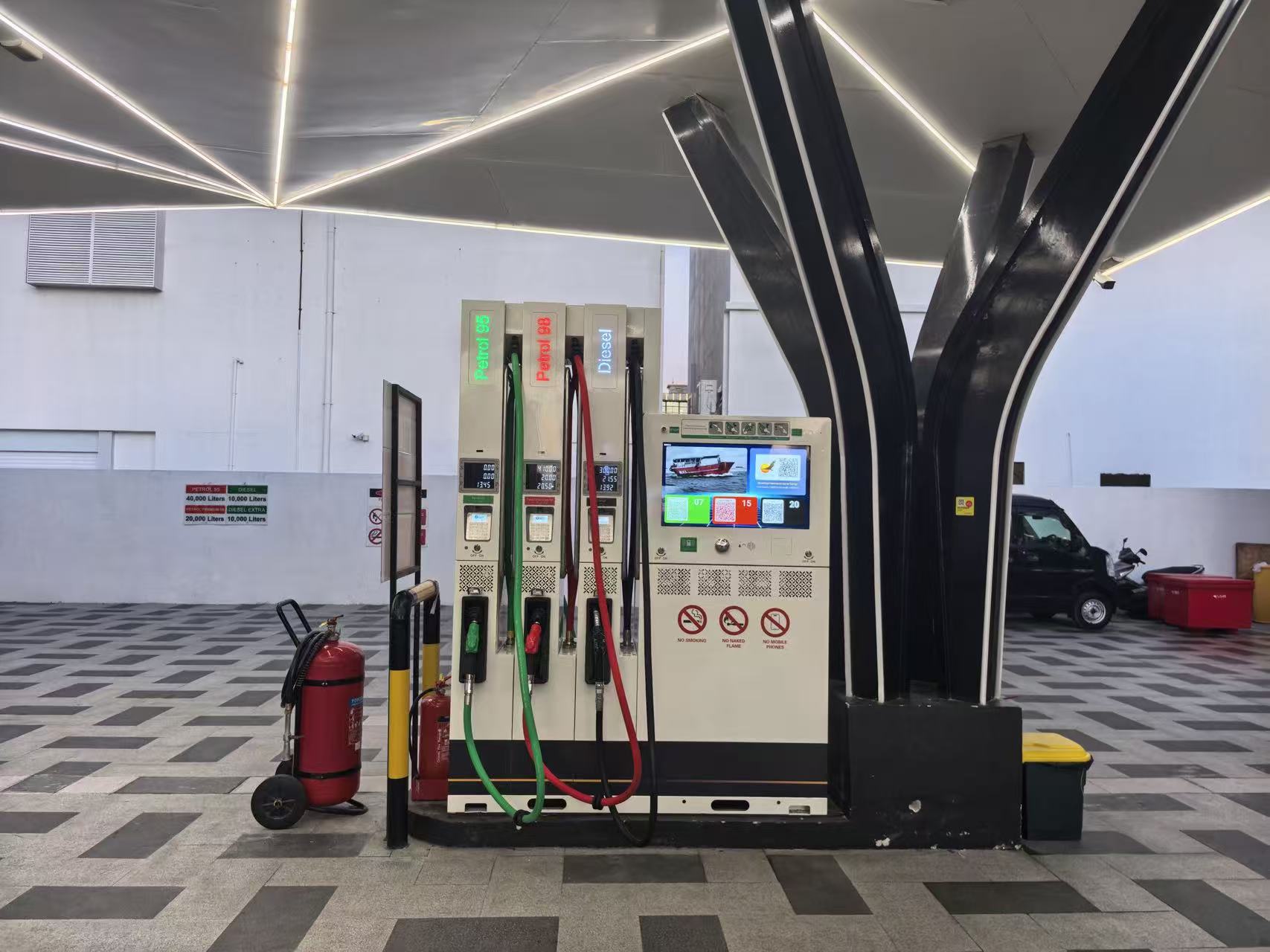
The meters that hold their calibration for ten years or more usually share one trait: they were never pushed outside a narrow thermal window. Inside the casing, the reference resistor or crystal that sets the measurement baseline degrades fastest when it cycles between hot and cold every day. Field data from utility deployments shows that units installed underground, where temperature swings stay within a few degrees, often pass decade-long audits with less than 0.2% drift.
Another factor that gets less attention is the quality of the solder joints on the sensing element. A tiny crack that opens and closes with humidity changes can introduce noise without causing a hard failure, and that noise slowly eats away at repeatability. Meters built with vapor-phase reflow and then conformal coated rarely develop this problem, which is why some industrial models still meet their original accuracy class after a decade while cheaper boards start to wander after three years.
Firmware also plays a surprising role. A meter that stores raw counts and applies temperature compensation in software can be recalibrated remotely without opening the housing, but only if the analog front end stays stable. The best designs include a self-check routine that runs every hour and compares the current zero offset against a factory-stored value; if the difference drifts beyond a preset band, the meter flags itself for service before the readings become unreliable. That proactive correction loop, more than any single component choice, explains why some instruments never lose their edge over a full decade.
The Components That Break Before the Pump Does
Most pump failures aren't caused by the pump housing or motor giving out first. Instead, a handful of smaller, less glamorous components tend to crack, wear, or seize long before the main body shows any real damage. If you know which parts are the usual suspects, you can catch problems early and avoid a full replacement.
Mechanical seals sit at the top of that list. They handle constant friction, heat, and pressure, and even a tiny bit of debris or a dry run can scar the sealing faces. Once a seal starts leaking, it's only a matter of time before the bearings get contaminated and the shaft wears unevenly. Bearings themselves are another weak point—they take radial and axial loads every second the pump spins, and without clean lubrication, they'll develop play or overheat fast. The impeller, especially in cheaper cast models, can also erode or crack from cavitation or abrasive particles long before the pump casing shows any fatigue.
Other early casualties include O-rings, gaskets, and wear rings. These soft or sacrificial parts are designed to fail first, acting as a buffer for the more expensive components. But ignoring their decay only pushes stress further down the line. A $5 O-ring that hardens and shrinks can cause a suction leak, which leads to air entrainment, which then damages the seal and bearings in a cascading chain. Keep an eye on the cheap, replaceable bits—they're the ones trying to tell you something before the pump gives up.
Interfaces Your Attendants Won't Hate Using
Most attendant-facing tools fail because they're built by people who never stand at a counter, gate, or bedside for eight hours. The result is a screen full of tiny buttons, nested menus, and confirmation dialogs that treat every routine task like a nuclear launch. A good interface starts by cutting those decisions down: one tap to check someone in, one swipe to flag a room, and no dead ends where a back button goes missing.
Beyond simplification, the visual hierarchy has to match how attendants actually think. Put the most frequent actions where thumbs rest, not in a hamburger menu. Use color sparingly—green for open, gray for closed, red only when something is genuinely blocked. And if a field can be filled later, don't force it as a required step. The goal is a flow that moves as fast as the attendant does, not one that demands they stop and decipher the screen.
Finally, test the interface during a real shift, not just in a conference room. Watch where people hesitate, which buttons they press by mistake, and when they reach for a supervisor. Those moments are the map for the next revision. When the tool quietly supports the work instead of interrupting it, attendants stop dreading the login screen—and that is the whole point.
Freezing Temperatures and Ethanol-Blended Fuels
Cold weather changes how ethanol-blended fuels behave in your vehicle. Ethanol attracts moisture, and when temperatures drop below freezing, that water can separate from the fuel and form ice crystals. This is especially common with E10 and higher blends left sitting in tanks or lines overnight. The result is often a hard start, rough idle, or even a no-start condition until the system warms up. Many drivers notice the problem more on short trips, where the engine never reaches full operating temperature to burn off the moisture.
Fuel system design also plays a role. Older carbureted engines and small power equipment tend to struggle more than modern fuel-injected vehicles, which usually have better seals and vapor management. If you store a car or boat over winter with ethanol fuel, adding a fuel stabilizer designed for ethanol blends can help prevent phase separation. Some mechanics also recommend keeping the tank nearly full to reduce air space where condensation forms. Draining the fuel entirely is another option for long-term storage, though not always practical.
In extremely cold regions, switching to ethanol-free fuel or using an anti-gel additive can make a noticeable difference. Ethanol itself has a lower freezing point than water, but the water it absorbs is the real culprit. Pay attention to symptoms like a sluggish throttle response or stalling after a cold start, as these may point to ice accumulation in the fuel filter or injectors. Regular maintenance, including replacing the fuel filter before winter, gives you one less thing to worry about when the temperature plunges.
Preventive Maintenance Without Closing the Lane
Preventive maintenance often conjures images of cones, detours, and frustrated drivers. But it doesn't have to mean shutting down a lane. Modern road crews use rolling blockades and shadow vehicles to protect workers while traffic keeps moving at reduced speed. They patch cracks, seal joints, and fix small surface defects during off-peak hours, so a full lane closure becomes the exception rather than the rule.
The key is timing and material choice. Quick-cure polymer patches and cold-mix asphalt allow crews to complete repairs in minutes, not hours. Teams work in short, mobile windows, pulling equipment off the road before rush hour returns. Some agencies even mount blowers, sweepers, and small patching machines on trailers that can be deployed from the shoulder without occupying a travel lane for long.
This approach doesn't just save drivers from delays—it extends the life of the pavement by addressing minor damage before it spreads. Routine visual inspections, often done from a moving vehicle or during scheduled shoulder work, help maintenance teams spot early cracking and pothole formation. By catching these issues early and repairing them in tight, lane-friendly windows, agencies keep traffic flowing and avoid the high cost of emergency full closures.
FAQ
Gilbarco and Wayne tend to dominate that conversation for good reason. Their mid-range models deliver consistent flow rates around 40 to 50 litres per minute while holding calibration well over years of daily use. Look for models with stainless steel meters and minimal electronics exposed to weather.
For a high-traffic forecourt, aim for 50 to 70 litres per minute on the diesel side and at least 40 litres per minute for petrol. Anything slower creates queues during peak hours. Just make sure your underground piping and filters can handle that throughput, otherwise the pump won't reach its rated speed.
Yes, several multi-product dispensers from Tokheim and Tatsuno are built with separate meters and valve assemblies for each fuel type. That design reduces cross-contamination risk and keeps recalibration intervals longer. You still need to check seals regularly, but daily switching between fuels won't throw off accuracy.
For a small operation with tanks close to the dispensers, a suction pump is cheaper and simpler to maintain. If your tanks sit more than 20 metres away or you run multiple high-flow nozzles at once, go with submersible pumps. They push fuel more efficiently and keep pressure steady across several lanes.
Change filters on a strict schedule, test meter accuracy at least twice a year, and inspect nozzles and hoses for wear before they start leaking. A lot of slowdowns come from clogged filters or damaged breakaway couplings, not the pump itself. Keeping the cabinet clean and checking for moisture also prevents electronic faults.
They can be, as long as you don't expect them to match the throughput of full-size units. Compact models from Bennett and Piusi work well for card-only or low-volume sites. Make sure the model has a robust payment interface and remote monitoring, since you likely won't have staff on site to spot issues early.
Gilbarco, Wayne, Tokheim, Tatsuno, and Dover are the names most often praised for durability. Bennett and Scheidt & Bachmann also have loyal followings in specific regions. The key is matching the brand to local service support, because even a great dispenser becomes a headache if replacement parts take weeks to arrive.
Conclusion
When a dispenser is pushed to 40 GPM, the real test isn't the pump motor or the hose reel—it's whether the meter can hold its calibration under that rush. The best units pair oversized metering chambers with turbine-style or positive-displacement designs that stay linear at high flow, so you're not giving away fuel or shorting customers. Meters that survive a decade tend to have hardened internals and sealed electronics, which matters more in cold climates where ethanol-blended fuels can form water layers or turn gummy. And let's be honest: the pump rarely dies first. It's the breakaway, the swivel joints, the filter manifold, or a frozen splash valve that takes a lane down. Choosing a model where those wear parts are easy to reach—and cheap to swap—changes the whole ownership math.
Attendants are the ones living with the interface every shift, so a cluttered screen or a seven-step authorization will quietly kill throughput. Look for dispensers with physical preset buttons, a readable backlit display, and card readers that don't need a reboot every time the temperature swings. In regions with real winters, ethanol blends demand extra care: water-absorbing filters, heated sumps, and drainable low-points keep phase separation from ruining a busy morning. Preventive maintenance should never mean closing a fueling lane. The smartest designs put filters, strainers, and diagnostic ports on the side or front, letting a tech swap a dirty element between cars instead of building a cone zone. That's the kind of thing that separates a top-ten dispenser from a showroom spec sheet.
Contact Us
Contact Person: Jason
Email: [email protected]
Tel/WhatsApp: 8615876017548
Website: https://www.bei-lin.com/