

Split-Core Residual Current Transformer: Why Choosing an Original Manufacturer Matters
2026-11-19
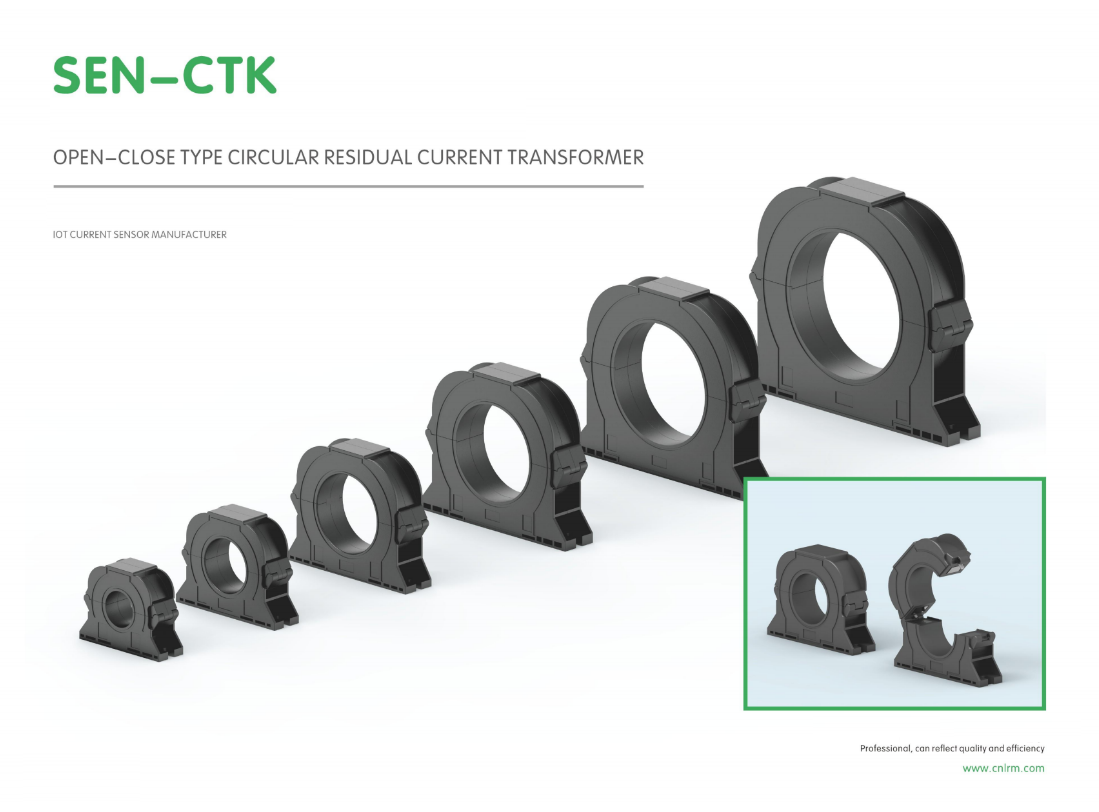
A split-core residual current transformer often looks like a simple clamp-on component, yet the difference between a dependable protection loop and a frustrating sequence of nuisance trips or missed leakage currents usually comes down to where it was actually designed and built. With Xiasen as an original manufacturer, the focus stays on core consistency, winding precision, and repeatable performance from batch to batch. This raises a practical question for engineers and procurement teams: are you specifying a proven sensing device, or just a part that happens to fit around the cable?
Inside the Split-Core Design That Keeps Residual Current Measurement Honest
The split-core design earns its place by allowing a residual current transformer to wrap around existing conductors without shutting down the circuit. That convenience, however, creates a mechanical interruption in the magnetic core. Two polished core halves meet at carefully machined mating surfaces, and the pressure between them has to stay consistent. Any tiny air gap or misalignment changes the reluctance path, which directly skews the low-level leakage currents the device is supposed to report.
What keeps the measurement honest is how the core handles those seams. The hinge and latch are not just mechanical afterthoughts; they set the repeatability of the magnetic circuit. When the halves close, the surface finish, plating, and spring tension work together to keep the effective gap stable across temperature swings and vibration. That stability matters because a residual current sensor often has to separate a few milliamps of real fault current from noise and normal capacitive leakage.
Shielding and winding placement do the rest. A tightly coupled secondary winding, distributed evenly around the core, reduces sensitivity to a conductor sitting off-center. Magnetic shielding around the outside prevents stray fields from adjacent cables or busbars from contaminating the measurement. The result is a split-core transformer that behaves less like a compromise and more like a solid-core device, preserving the accuracy that safety decisions depend on.
When a Cheaper Core Hides a Costlier Safety Problem
A motion control board gets swapped for a lower-priced equivalent after a short bench test. The pinout matches, the firmware accepts it, and the savings look real on the purchase order. What stays invisible is the supplier's thinner solder mask, a missing conformal coating step, and a batch of diodes that barely clears the voltage margin. The first intermittent shutdowns look like software or wiring faults, so the real cause stays buried for weeks.
Once the failures spread, the cost picture flips. Engineers stop building to chase field returns. Service crews replace parts on guesswork. Production schedules slip while a safety investigation drags on. The per-unit savings shrink beside the overtime, rework, and warranty exposure that a safety-critical core can create when it fails quietly.
A cheap core rarely stays cheap if it controls a safety function. The price that matters includes change control, traceability, and what happens after the part leaves the factory. Otherwise the discount becomes a down payment on a much larger problem.
The Calibration Chain Most Buyers Never See
Most people picture calibration as a sticker on the back of a gauge or a folder of certificates in a drawer. The part they never see is the chain behind that signature: the reference standards kept in a temperature-controlled room, the intermediate instruments that carry the comparison down from a national lab, and the technicians who run repeated cycles just to quantify drift before it shows up in a product. Each link has its own uncertainty, and if one link is soft, the number at the end looks confident but isn't.
There is also a quiet choreography of environment and timing. Humidity, warm-up intervals, cable seating, even the order in which points are taken can nudge a reading. Buyers rarely watch a lab reject a perfectly good instrument because the room drifted half a degree during the run, or see a master standard sent out for months and the whole schedule rearranged. That invisible work is what separates a real calibration from a printed date.
Why Original Manufacturer Testing Is Not a Formality
A genuine test program at the original manufacturer digs into failure modes that only surface under combined stress. Thermal cycling, vibration, fluid exposure, and sustained electrical load are often run simultaneously rather than as isolated checks. That overlap matters because a connector that survives heat alone may crack when heat is paired with minor misalignment or a slightly degraded seal. The data logged during these runs feeds back into tooling adjustments and assembly torque settings, which is not the kind of insight a simple pass/fail inspection provides.
Material batches and supplier processes drift in ways that drawings cannot fully predict. One lot of elastomer may cure slightly harder; a revised plating line may leave a marginally thinner edge. Original manufacturer testing catches these shifts before parts leave the factory by comparing current samples against reference units under identical conditions. The goal is not to re-approve the design but to verify that this particular production run still behaves like the design intent. That distinction is easy to miss when testing is treated as paperwork.
There is also a human side to the process. Experienced test engineers learn to listen for subtle changes in noise, watch for faint discoloration, and question values that look acceptable but sit near the edge of a limit. Those observations often trigger teardown inspections or additional cycles, even when the formal specification does not require them. A signed certificate cannot carry that judgment. It exists only because someone ran the part hard enough to expose weakness before a customer could.
Matching the Transformer to Your Protection Relay Without Compromise
Selecting a transformer for a protection relay often gets reduced to a quick spec check, but the real work happens in the margins where nominal ratings stop being useful. A relay doesn't see the transformer as a nameplate; it sees inrush currents, saturation curves, and the messy reality of short-circuit behavior. If you only match voltage and current ratings, you inherit blind spots that surface during the exact events the relay is meant to catch. Thinking through the magnetizing characteristics and how the relay interprets them is where a reliable setup actually starts.
Knee-point voltage and burden get most of the attention, yet they rarely tell the whole story. A transformer can look perfect on paper and still distort the secondary waveform enough to confuse a digital relay's filtering algorithms. The trick is to pair the transformer's actual excitation curve with the relay's sampling behavior, not just its pickup thresholds. This means checking not only whether the relay can read the signal, but whether it reads it the same way under fault conditions as it does during routine loading.
The phrase 'without compromise' matters here because every shortcut shows up later as nuisance tripping or, worse, a failure to trip. You don't need exotic hardware or over-specified margins; you need a deliberate match between the transformer's physical limits and the relay's decision logic. Once that fit is right, the protection scheme stops being a collection of components and starts behaving like a single, coherent system.
Long-Term Drift, Field Conditions, and the Case for Traceable Builds
When a build remains reproducible in a controlled lab environment, it is easy to assume that the same result will hold months or years later on a machine that has never been touched by the original developers. That assumption tends to break down quietly. Compilers get patched, system libraries shift beneath the code, and even the way a filesystem orders files can introduce subtle variations that accumulate into real differences. Long-term drift is rarely dramatic; it shows up as a checksum mismatch, a slightly different archive size, or a binary that fails to run on hardware that was never part of the test matrix.
Field conditions add another layer of noise. A device deployed in a factory or on a remote weather station might be rebuilt from source using a toolchain that has been updated five times, on an operating system image that was never archived, with locale settings and time zones that differ from the developer workstation. Without a traceable build record, diagnosing why the field unit behaves differently becomes guesswork. Traceability means more than storing a commit hash; it requires recording the full set of inputs, environment variables, patch levels, and build flags that produced each artifact, as well as the order in which they were applied.
The case for traceable builds rests on a practical observation: software does not age in isolation. Its environment ages, and the assumptions baked into a build slowly detach from the systems that actually run it. Teams that keep a signed manifest alongside every release can walk backward from a failing field report to the exact source tree and build recipe that created the binary. That ability to reconstruct the past without relying on memory or institutional folklore is what turns a mysterious regression into an ordinary debugging task.
FAQ
The internal core material, winding consistency, and how the housing is sealed usually differ. A genuine unit tends to hold its accuracy over a wider temperature range and after repeated clamping, while copies may drift or crack at the hinge.
Yes. The original manufacturer controls the core annealing process, the exact air gap dimensions, and the secondary winding tension. Those details are hard to copy from an external photograph and directly affect trip thresholds and false tripping.
You may get mixed batches, changed internal geometry, or cores that saturate earlier than specified. When that happens, residual current detection becomes unstable in the field, and tracing the root cause is harder because the supply chain lacks direct engineering records.
The split joint introduces small air gaps and alignment tolerances. Small manufacturing variations there can shift phase angle and linearity enough to cause nuisance trips at harmonics or slow response to real leakage currents.
Ask for the actual factory markings, batch test data for the specific core, and whether the manufacturer will issue a certificate with the transformer's measured accuracy rather than a generic catalogue sheet. Also confirm the split mechanism has been endurance-tested under repeated open-close cycles.
It can pass a bench test and still fail later. The issue is often mechanical: hinge wear, weak clamping force, or a housing that warps after heat aging. Those failures increase the air gap and degrade residual current sensitivity in service.
Original manufacturers typically use controlled core cutting and polishing, stable epoxy curing, and calibrated test fixtures. That keeps the residual flux and air gap predictable, so the trip threshold remains stable after installation instead of drifting over months.
When the transformer is installed in hard-to-access panels, used with adjustable residual current relays, or required for safety certification. In those cases, inconsistent magnetic performance or mechanical loosening is expensive to diagnose and can leave a protection gap.
Conclusion
A residual current transformer is only as trustworthy as the geometry and core material hidden inside its split housing. The hinged design that makes retrofit installation easy also introduces air gaps, uneven flux distribution, and mechanical stress at the parting line. Original manufacturers control these variables by matching core laminations, keeping contact faces flat, and verifying that the secondary winding remains centered after repeated opening and closing. That is not the case with generic copies, where a slightly softer magnetic core or a looser clamp may still pass a bench test but drift once exposed to vibration, temperature swings, or minor misalignment. In residual current measurement, small errors at low primary currents are exactly where protection becomes unreliable.
Cheaper cores often disguise their weakness until a real earth fault occurs. A unit that reads a few percent high or low under factory conditions can allow a relay to miss a developing insulation fault or, conversely, nuisance trip on harmless leakage. The less visible risk is calibration. Reputable original manufacturers tie every ratio and phase-angle check to traceable reference equipment, and they test for linearity across the full burden range the relay will present. They also match the transformer's knee-point and burden rating to the protection relay, avoiding saturation during high-current faults while preserving sensitivity for low-level leakage. Long-term field behavior matters just as much: original builds use encapsulated windings, stable core alloys, and documented batch traceability so that performance ten years later still resembles the original test certificate. Without that chain, a split-core transformer becomes a weak link in a safety system no one can inspect after installation.
Contact Us
Contact Person: Liu Mengyang
Email: [email protected]
Tel/WhatsApp: 8618727589233
Website: https://www.cnlrm.com/en/