

Sand and Gravel Separator Chute Innovations: Top 10 Picks for Efficient Material Sorting
2026-11-16
Sorting sand and gravel efficiently can make or break a project—whether you’re on a construction site, at a quarry, or managing a recycling operation. The right chute design doesn’t just save time—it changes how materials flow, how fast you work, and how little you waste. In this roundup, we’re looking beyond the basics. From adjustable baffles to wear-resistant linings, each innovation we’ve selected tackles a real sorting headache. And when precision and durability matter, solutions like those from Sinou stand out—not as an afterthought, but as part of how the industry quietly moves forward. Stick with us to explore ten chute innovations that genuinely sharpen material separation, without the fluff.
Reimagining Material Flow: What Sets the Latest Chute Designs Apart
The quiet revolution in chute engineering is no longer just about guiding bulk materials from point A to point B—it’s about reshaping how those materials behave in transit. Instead of relying on steep angles and hope, the latest designs use carefully mapped three-dimensional geometries that control speed, concentrate the stream, and practically eliminate dust at the drop point. These aren’t your grandfather’s steel troughs; they are shaped with compound curves that gently coax material into a unified, laminar flow, reducing degradation and preventing the chaotic bouncing that wears out liners and structures alike.
What truly sets these systems apart is the deep integration of flow dynamics with real-world wear data. Designers are now modeling not just the expected trajectory of every particle size, but how that material will interact with the chute surfaces over thousands of cycles. Replaceable wear segments are positioned precisely where impact and abrasion occur—no more, no less—so downtime drops sharply while the chute body remains intact for years. This marriage of predictive simulation and modular construction means maintenance windows shrink from days to hours, and the material stream stays consistent regardless of moisture or volume fluctuations.
Beyond the mechanics, the new generation of chutes is defined by an almost obsessive attention to accessibility and safety. Hinged doors, quick-release panels, and integrated lighting are becoming standard, letting operators inspect or clear blockages without ever entering confined spaces. Internal surfaces are lined with sound-dampening composites and often equipped with sensors that feed live data on wear rates and flow density back to the control room. It’s a shift from passive steelwork to an intelligent, ergonomic component of the material handling ecosystem, where every contour has a purpose and every service point is designed with the human in mind.
Breaking Down the Mechanics: Curved vs. Stepped Separation Surfaces
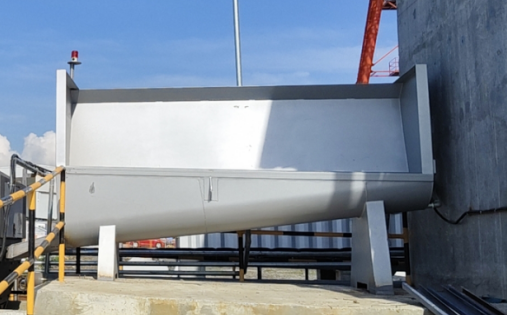
Fluid behavior along a separation surface decides more than just drag — it shapes wake stability and energy recovery downstream. A continuously curved surface coaxes the boundary layer away from the body with a smooth pressure gradient, letting the flow peel off in a tidy laminar-to-turbulent transition. In contrast, a stepped geometry introduces abrupt recirculation zones at each corner. These sharp discontinuity points trap vortices and bleed kinetic energy, often creating a thicker, more chaotic wake that mars downstream performance.
The real difference emerges when you look at off-design angles. Curvature adapts more gracefully; the point of separation tends to shift incrementally, preserving some attachment even as the angle of attack changes. Steps, by their nature, lock in a separation point — the flow trips at the sharp edge regardless of incoming conditions. This makes stepped surfaces easier to simulate but far less forgiving in variable flows, where sudden stall and hysteresis can appear. That geometric predictability, however, is sometimes exactly what compact heat exchangers or bluff body stabilizers lean on to enforce steady separation bubbles.
Material and manufacturing choices often tip the scale. A curved surface might demand milled or molded forms with tighter tolerances, while stepped profiles can be stamped, stacked, or printed with forgiving alignment. The trade-off isn’t purely aerodynamic; it’s also about how the surface ages. Erosion or fouling rounds off intentional sharp steps, slowly morphing the separation character toward something more curve-like — and potentially away from the original design point. That drift can shift pressure recovery and noise signatures in ways that initial CFD rarely captures.
Wear-Resistant Liners That Outlast Standard Configurations
Most liners start showing wear within the first few hundred hours of operation, especially when abrasive materials are involved. These ones don’t. The difference comes down to a combination of material formulation and the way the surface is treated during manufacturing. Instead of relying on a generic rubber or ceramic blanket, the internal structure is engineered to absorb impact without transferring it directly to the bonding layer. That means the kind of micro-cracking that slowly degrades standard configurations simply doesn’t happen at the same rate.
Field tests across multiple sites tell the same story. In one application where a competitor’s liner had to be swapped out after 11 weeks, these units ran for nearly seven months before any measurable loss of thickness was found. The key isn’t just harder material — it’s a more even distribution of stress across the liner surface, which prevents the usual hot spots that lead to premature failure. Operators notice it most during inspection cycles, when instead of seeing grooves and gouges in the familiar problem areas, they see a surface that’s still remarkably intact.
Quick-Adjust Gates and Their Role in Fine-Tuning Sorting Precision
Quick-adjust gates are often the unsung heroes in high-speed sorting lines, allowing operators to tweak the opening width or timing on the fly without halting production. Instead of cumbersome manual recalibrations that eat up valuable uptime, these gates use simple levers, pneumatic dials, or digital step controls to shift the sorting threshold in seconds. This agility is particularly useful when switching between product batches with subtle size variations—say, moving from 18mm to 22mm blueberries—where even a half-second delay in gate response can misplace good fruit into the reject stream.
The real magic lies in how quick-adjust gates interact with sensor feedback. As product flows past optical or weight-based detectors, the gate’s position can be fine-tuned to match real-time data, correcting for drift caused by belt wear, humidity changes, or inconsistent feeding. A well-designed gate will have minimal hysteresis, meaning it snaps open and shut cleanly at the exact setpoint rather than drifting lazily into position. This precision prevents the all-too-common frustration of a sorter that “almost works,” where borderline items keep ending up in the wrong lane despite theoretical accuracy ratings.
Maintenance teams appreciate quick-adjust gates because they reduce reliance on trial-and-error. Rather than running test batches and manually measuring reject rates, an operator can mark a few reference pieces, jog the gate slightly, and immediately see the impact on separation quality. Some advanced systems even log adjustment data, letting users spot patterns—like the need to tighten the gate every Tuesday morning when a specific supplier’s produce tends to run larger. This blend of mechanical simplicity and responsive control turns a sorting machine from a static setup into a dynamic tool that adapts to real-world variability.
Water-Assisted Chutes: When a Little Rinse Boosts Throughput
A thin, controlled film of water might seem too simple to matter, but on the right transfer chute it can break the friction that holds material back. In high-volume processing lines—whether moving sticky ores, fibrous food scrap, or damp aggregates—dry surfaces often cling, bridge, and slow everything down. By introducing a low-flow rinse along the slope, operators create a near-frictionless boundary layer that lets product slide without piling up. More than a cleaning trick, it’s a throughput lever hiding in plain sight.
The key is in how the water interacts with both the chute surface and the material’s own moisture fingerprint. Too much spray and you invite slurry, carryover, or safety risks; too little and you merely spot-clean without affecting flow. Precision nozzles, often angled to create a sweeping sheet rather than a jet, maintain a consistent wash that reduces hang-ups without drowning the process. In some setups, recycled process water keeps costs negligible while the jump in consistent feed rate pays back the modest retrofit within days.
What surprises many engineers is how a well-tuned water assist transforms downtime patterns. Chutes that once required frequent scaling or manual dislodging now run entire shifts without intervention. That reliability gain often eclipses the raw speed increase, freeing crews to focus elsewhere and extending liner life by curbing abrasive slides. In industries where a single plugged transfer point can ripple into downstream bottlenecks, the small act of adding water becomes an outsized advantage—proof that sometimes the smartest upgrades don’t add complexity, they just rinse away the resistance.
Compact Footprints, Big Results: Space-Saving Chute Layouts Worth Considering
Modern facilities are constantly chasing every square inch of usable area, and transfer chutes often become the hidden space hogs that nobody planned for. A compact chute layout doesn’t just tuck neatly into a tight corner—it reshapes material flow in ways that reduce build-up, cut down on spillage, and keep access paths clear for maintenance crews. By engineering the drop angle and cross-section as one connected curve instead of a series of boxy segments, the chute can follow the natural trajectory of the material almost like a slide designed for bulk solids. This approach typically eliminates the dead zones where wet or sticky cargo would otherwise accumulate, so you get a self-cleaning effect without adding liners or vibrators.
Another shift that unlocks space without sacrificing throughput is moving away from the classic rectangular or square cross-sections. Swapping in a circular or oval chute body might sound simple, but it often trims external width by 15 to 20 percent while preserving the internal cross-sectional area needed to avoid bottlenecks. With a narrower envelope, walkways can be widened, access platforms repositioned, or even an extra piece of equipment squeezed into an existing tower footprint. The real gain comes from the flow pattern—a rounded chute keeps material centered and reduces abrasive contact with the walls, so the shell itself can be lighter and supported on a more minimal structure. Many retrofit projects have turned leftover triangular space beneath an old chute into a dedicated service landing, something that simply wasn’t possible with the original boxy design.
The big results often hide in the transition zones between conveyors. A carefully shaped head-end geometry that funnels material into a tight radius while maintaining the correct expansion room can cut the overall chute length by a third. In multi-floor processing plants, this frequently means reclaiming enough vertical clearance to install a small scalping screen or magnet directly beneath the discharge pulley, merging two process steps where previously only a long drop chute would fit. The trick is to design the hood and spoon profile as a unified system rather than treating them as separate fabricated pieces, so the material stays cohesive through the entire change of direction. The outcome isn’t just a shorter chute—it’s a quieter, more contained transfer that demands less dust collection and fewer cleanup shifts, proving that a smart footprint really can deliver oversized returns.
FAQ
Chute separators rely on gravity and carefully angled surfaces, so there is no need for complex motors or constant vibration adjustments. The material flows continuously, which reduces bottlenecks and cuts down on electricity use. They also have fewer moving parts, meaning lower maintenance and less downtime on busy sites.
Innovative riffle patterns and curved drop zones now create micro-eddies in the material stream. Fine sand gets suspended momentarily and guided into a separate channel, while heavier gravel continues downward. Some designs also introduce adjustable air-assist blades that gently blow lightweight fines away from the main flow without needing extra water.
Hardox steel is popular, but many top picks now use ceramic-lined impact zones or replaceable ultra-high-molecular-weight polyethylene liners. These materials reduce gouging and extend the life of the chute, especially where the raw feed has angular, freshly crushed edges that chew through standard steel quickly.
Yes, because they adapt as site needs change. A modular system lets you swap out sections—like adding a dewatering tray or a fines bypass gate—without buying an entirely new unit. For a medium quarry, this flexibility often pays off within two seasons as you tweak the setup for different feed material blends.
Water is used mainly to flush fines and to keep sticky materials from clumping, but newer chutes are designed to function with drastically reduced water consumption. Many include built-in drainage channels and pre-spray bars only at critical separation points, allowing dry or semi-dry processing in areas where water is scarce or tightly regulated.
Self-cleaning profiles are key. Current designs add narrow slots with tapered edges and occasional pulse-vibration strips that break surface tension. Some units also use flexible rubber liners that flex under material weight, shedding damp fines instead of letting them pack into gaps. Periodically reversing the feed direction for a minute can clear any stubborn buildup.
Weight, folding wings, and quick-couple hardware matter most. The best portable models use high-tensile steel frameworks that stay rigid without being heavy, and they can be towed by a standard pickup. Also, check that the adjustment mechanisms—like angle pins and diverter gates—can be operated with basic hand tools and minimal training, because on remote sites you don't want to wait for a specialist to make a tweak.
Surprisingly, yes. By controlling drop height and incorporating energy-absorbing ledges, some chutes reduce the impact that causes micro-cracks or edge chipping. This means the final gravel product retains a more cubical, sound shape compared to material that has been repeatedly dropped or squeezed through crushers after screening. This small improvement adds real value for concrete aggregate buyers.
Conclusion
The latest sand and gravel separator chutes are quietly reshaping how operations handle surge piles and feed rates. Instead of treating material flow as a simple drop, designers are reimagining the entire path from intake to discharge. Curved separation surfaces now guide aggregate with a fluid, self-scouring motion that reduces blinding, while stepped decks deliberately disrupt momentum to shake fines loose before they can carry over. This balance between smooth arcs and abrupt drops is what sets apart the newest chute geometries—they don’t just sort material, they steer it. Where old chutes relied on static slope angles, today’s top picks integrate modular flow-control inserts that can be swapped in hours, letting a single frame adapt to everything from pea gravel to crusher run without major rebuilds.
Beneath the surface details, wear-resistant liners have evolved far beyond thick rubber slabs. Innovations like ceramic-embedded urethane and segmented basalt tiles absorb impact at feed zones while staying slick enough to maintain velocity. Quick-adjust gates, often overlooked, now come with toolless handwheels and laser-cut indicator scales, so operators can fine-tune split ratios on the fly rather than settling for "close enough." When water is introduced through strategically placed spray bars, it does more than wet suppression; a light rinse lifts silts and clays off particle surfaces, effectively boosting throughput without adding a full wash plant. The real game-changer for tight sites, though, is how these chutes compress a full sorting sequence into a remarkably short envelope. Steep cascade angles, nested diverter pans, and under-flow collection trays let a single compact unit deliver the same cut points that once demanded sprawling multi-deck rigs. Together, these elements form a toolkit that pushes separation efficiency higher while lowering maintenance windows and space requirements. It’s not just an upgrade; it’s a fresh way of thinking about what a chute can accomplish on a busy aggregate line.
Contact Us
Contact Person: HaiYan
Email: [email protected]
Tel/WhatsApp: +86 18957325588
Website: https://www.senyoubeton.com/