

Electric Wheelchair for the Disabled Company Transforming Lives Through Mobility
2026-08-17
What if an electric wheelchair didn't feel like a limitation, but like a passport to the life you've been missing? That's the quiet revolution underway at Freedomchair, where mobility for people with disabilities is being reimagined from the ground up. Forget clunky machines and sterile designs—this is about dignity, independence, and the everyday thrill of going where you want, when you want. Here's a look at how one company is transforming lives through movement.
Rethinking What 'Independence' Means for Wheelchair Users
The usual picture of independence shows a person handling everything alone—lifting bags, opening doors, moving through the day without asking for help. For someone who uses a wheelchair, that image rarely fits, and chasing it can make life harder. Plenty of wheelchair users learn that real independence isn’t about doing every physical task solo. It’s about deciding where to go, when to leave, and how to spend the day. A missing ramp or a narrow doorway doesn’t just limit movement; it takes away control over choices most people never have to think about.
A more useful definition centers on autonomy and dignity, not physical isolation. Asking for help reaching a high shelf or transferring into bed doesn’t erase independence if the person is still calling the shots. What actually undermines it is the assumption of helplessness—a stranger grabbing the back of a chair without asking, a building that forces a side entrance, a system that treats assistance as a sign of failure. Independence, in this view, means having the power to say no, to set the pace, and to use tools or other people’s help without losing standing.
The Engineering Behind a Chair That Climbs Curbs Without a Flinch
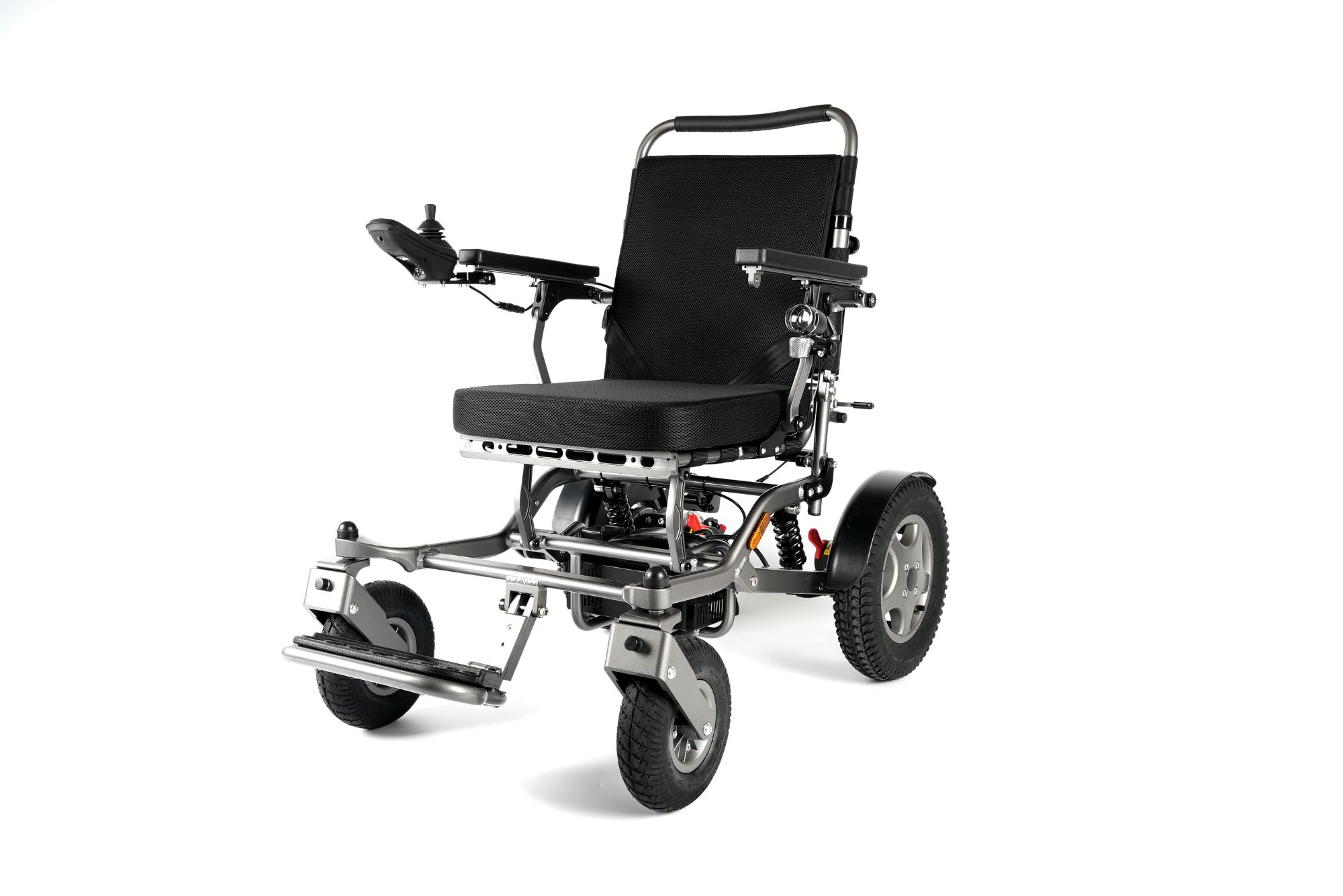
At the core of this curb-climbing chair is a pair of swing-arm front casters that pivot independently when they meet an edge. Instead of relying on brute force to lift the entire frame, the chair channels forward momentum into a small lifting action: each caster rocks upward and over the obstacle, then snaps back into place on contact with the ground. A torsion spring inside the pivot joint stores energy during the initial impact and releases it just as the wheel clears the curb, giving the front end a subtle boost without jolting the rider.
The rear drive wheels use a hub-mounted differential that lets each side rotate at a different speed, so the chair can square up to a curb at a slight angle and still climb evenly. A low-friction slider plate under the footrest acts as a temporary skid, preventing the front frame from digging into the concrete if the casters are momentarily unloaded. This plate is coated with a wear-resistant polymer that glides over rough edges rather than catching on them.
All of these parts are tied together by an adjustable anti-tip bar positioned just behind the rear axle. When the chair pitches backward during a climb, the bar contacts the ground and shifts the center of gravity forward, keeping the drive wheels pressed firmly against the curb face. The result is a chair that treats curbs as a normal part of the path, not an obstacle to be avoided.
Real Stories: From Watching Life Pass By to Living It Out Loud
For years I treated my own life like a spectator sport. I’d scroll through other people’s adventures, tell myself I was “researching” or “waiting for the right time,” and then feel that dull ache when another weekend slipped by unchanged. The turning point wasn’t dramatic. It was a Tuesday afternoon when I realized I had stronger opinions about a stranger’s kitchen renovation than about what I actually wanted to do that evening. That was the moment I stopped watching and started making small, deliberate choices that felt like mine.
Living out loud began with embarrassingly tiny steps. I said yes to a coworker’s invite for coffee even though I’d already planned to go home and watch a show. I took a pottery class where my first three bowls collapsed. I started telling people about the things I loved without pre-apologizing for them. None of it looked impressive from the outside, but each small yes made the next one easier, and slowly the life I’d been observing from a distance started to have my fingerprints all over it.
The real shift wasn’t becoming louder or busier. It was learning to treat my own curiosity as a good enough reason to move. Now when I catch myself slipping back into passive mode, I ask one question: “Would I rather have a story about this, or just a memory of watching someone else’s?” Most of the time, that question is enough to get me off the sideline and into something real, messy, and worth telling.
Why Our Batteries Outlast a Full Day of Errands and Adventures
It starts with the chemistry inside the cell. Instead of squeezing maximum capacity into a thin profile and hoping for the best, we pair a high-density lithium-ion core with a power management chip that learns how you actually use your phone. On a busy day of map navigation, quick photos, and streaming music between stops, the chip steers power away from idle background tasks and toward the screen, camera, and connectivity you are actively tapping. That real-time adjustment keeps the voltage curve flatter for longer, so the 30% you see at 7 PM behaves like the 30% you saw at noon.
Thermal design matters just as much as chemistry. Heat is the silent killer of battery endurance, and most phones let warmth build up near the processor and display. We route heat along a graphite sheet and a vapor chamber that spreads it across the back panel instead of trapping it against the cells. The result is a battery that stays cooler during an afternoon of video calls or a long drive with GPS running, which reduces internal resistance and prevents the rapid drain you feel when other devices get hot in your hand.
Finally, the battery is built to handle the messy reality of errands and adventures. You might plug in for ten minutes at a coffee shop, leave it on a wireless charger in the car, or top up from a power bank while hiking. Our adaptive charging firmware smooths out those irregular top-ups and avoids the micro-cycles that age a battery quickly. After months of inconsistent charging, you still get a full day because the cell holds its capacity longer—no need to hunt for an outlet before dinner or carry a spare battery just in case.
Design Choices That Respect Your Body, Not Just Your Diagnosis
Too many products are built around a diagnosis code instead of the person living in the body. A glucose monitor that assumes steady hands and clear eyesight fails the person with arthritis or retinopathy. Respecting your body means designing buttons you can press without pain, screens you can read in low light, and alerts that don't shame you for a spike at 3 a.m.
The real test is whether the device fits into the small, stubborn rhythms of your day—not the other way around. If the cuff is too stiff to wrap one-handed, or the app demands a level of fine motor control you lost years ago, it's not a thoughtful design. It's a diagnosis with a plastic shell.
So we keep asking: Does this choice reduce friction on your skin, your joints, your routines? Does it let you be tired, distracted, or in pain without being penalized? That's the difference between designing for a condition and designing for a human.
How We Build Chairs Around Real Homes, Not Showrooms
Most chair makers start with a showroom floor: perfect lighting, bare walls, nothing but the chair demanding attention. That approach flatters a design but says nothing about how it survives a spilled bowl of cereal or a teenager flopping down after practice. We do the opposite. Our team visits actual homes—apartments with radiators, houses with dogs and uneven floorboards—and watches how people really sit. We measure the tight corner between a sofa and a bookshelf, note the way a cat claws at fabric, and listen when someone complains their last chair made their back ache by dinner.
From those notes, we build differently. A chair meant for a real living room needs arms that can take a kicking foot, a seat depth that doesn't swallow shorter legs, and a fabric that forgives coffee drips. We skip the fragile veneers that look great in a catalog but crack by the second winter. Instead, we choose joinery that stays quiet when someone shifts their weight, and cushion foam that doesn't go flat after six months of movie nights. The result isn't a museum piece. It's a chair that earns its place between the window and the toy basket.
This also means we test in messy contexts. We ask families to live with prototypes for weeks—not to pose them in a staged corner. A chair passes only if it survives a toddler's climb, a laptop balanced on one arm, and the occasional nap that starts upright and ends sideways. If a design only works when nobody touches it, we send it back to the shop. Chairs should adapt to homes, not the other way around.
FAQ
We design and build electric wheelchairs for people with disabilities, focusing on comfort, reliability, and the kind of independence that comes from moving freely.
By giving users the freedom to move on their own terms, our chairs open up daily routines, social connections, and work opportunities that limited mobility used to block.
Every chair is fitted with intuitive controls, long-lasting batteries, and seating that adapts to individual body shapes, so users get support that feels personal rather than one-size-fits-all.
Adults and seniors with mobility challenges, including spinal cord injuries, muscular dystrophy, multiple sclerosis, and post-surgery recovery, as well as caregivers looking for dependable assistive technology.
Yes, they handle tight indoor corners and rough outdoor terrain equally well, with anti-tip wheels, reliable brakes, and weather-resistant frames.
Absolutely. We offer adjustable seat widths, backrest angles, joystick placement, and color choices, so the chair fits the user's body and lifestyle instead of forcing the user to adapt.
Our team provides setup guidance, maintenance tips, and a responsive service line, plus spare parts that ship quickly to keep your chair moving.
You can book a free consultation through our website or call our team. Many regions also offer in-home demonstrations so you can try the chair in your own space before deciding.
Conclusion
Forget the old idea that a wheelchair simply gets you from one room to another. Our work starts by asking what independence actually feels like when you can leave your front door without planning every curb cut in advance. That question led to a chair that lifts itself over street edges and uneven thresholds without a jolt, because the engineering goal was never just stability—it was calm. A mother told us she used to watch her kids play from the porch; now she follows them to the park and waits at the bottom of the slide. Those are the stories that push our battery lab to keep going until a single charge covers errands, appointments, and an impulsive detour for ice cream, with power to spare.
We also stopped designing for showrooms and started measuring real hallways, bathroom doorways, and the tight turn at the top of the stairs. That means armrests and back supports shaped to how your body actually rests, not how a diagnosis looks on a chart. If your kitchen counters are an inch too high or your front step is cracked, we adapt the chair around those details instead of asking you to renovate your life. Mobility isn't a feature list; it's the freedom to be the person your dog expects when you reach for the leash.
Contact Us
Contact Person: Calvin Fan
Email: [email protected]
Tel/WhatsApp: 8618913265607
Website: www.freedom-chair.com