

Custom Warning Projector Setups That Improve Visibility and Safety
2026-11-17
Every fleet manager knows the frustration of a warning light that only works when someone is already too close. But what if the problem isn’t the light itself—it’s where and how it’s mounted? In this guide, we break down custom warning projector setups that turn overlooked mounting points into high-visibility safety tools. From angled brackets to shielded housings, these configurations are built for real-world conditions, not just showroom floors. And when precision optics matter, TNT projectors are often the difference between a warning that’s seen and one that’s ignored.
Where Standard Warning Projectors Blend Into the Background
Standard warning projectors often fade into the visual noise of factory floors and warehouse ceilings, leaving their messages unnoticed until it is too late. The very point of a warning is to interrupt routine, yet conventional units do exactly the opposite: their fixed beams, muted colors, and predictable placement train the eye to ignore them. If a safety alert looks like every other fixture in the room, workers stop registering its presence altogether. The result is not a failure of signage but a failure of contrast—a warning that has quietly become part of the background.
The problem deepens when maintenance schedules lag. A dull lens, a scratched housing, or a slightly misaligned mount can strip a projector of what little visibility it had. Over time, even the most well-intended safety system drifts into irrelevance, not because the hazard disappeared, but because the alert stopped competing for attention. True visibility requires more than a bright light; it demands a deliberate break from the surrounding environment. Without that break, the projector is just another shadow on the wall.
Effective warning design treats attention as a finite resource. Bold color shifts, irregular placement, pulsed patterns, and dynamic beam movement force the eye to renegotiate what belongs where. When a warning projector refuses to blend in, it reasserts the boundary between routine and risk. That distinction—not brightness alone—is what turns a forgotten fixture into a signal that actually protects people.
Matching Projected Warnings to Real Blind Spots, Not Just Open Floors
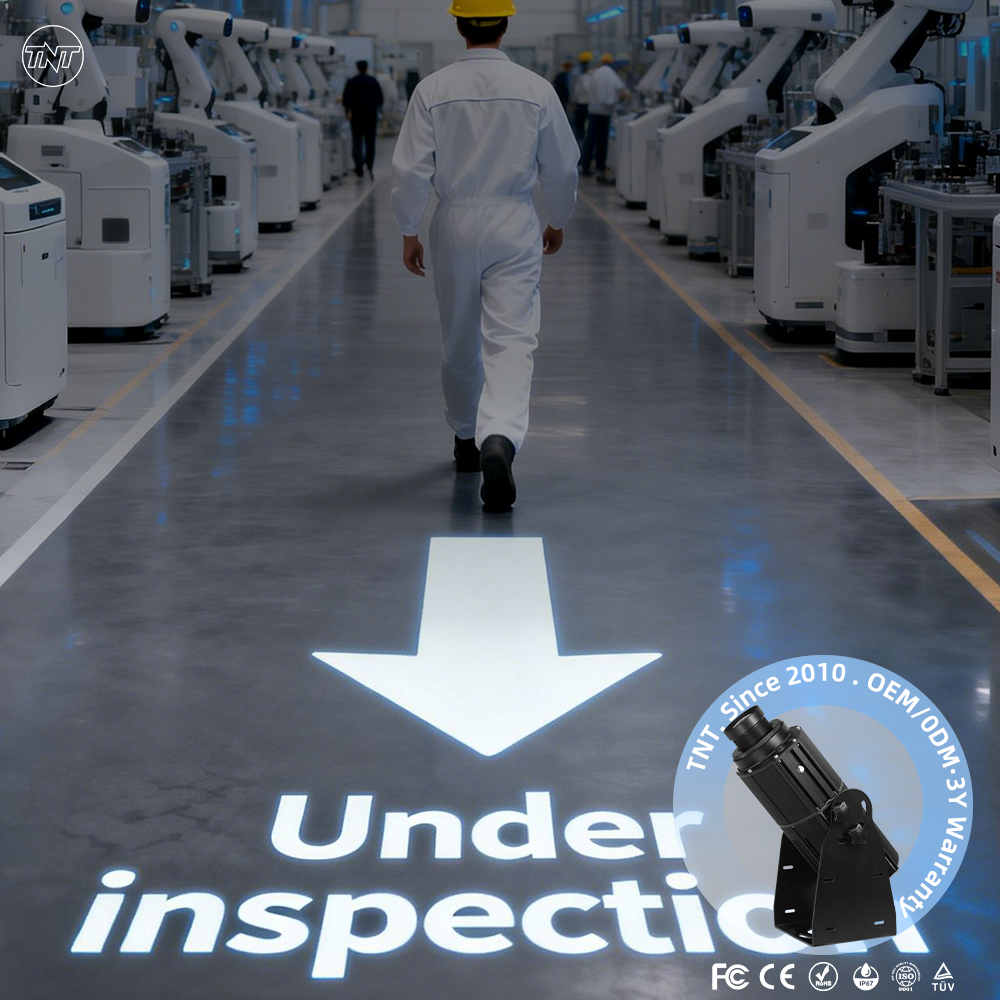
Most warning systems treat a blind spot as an empty rectangle on a map, flashing alerts whenever someone steps into a zone with no direct line of sight. That works fine for warehouses with wide aisles and predictable traffic, but real sites rarely behave that way. A forklift reversing around a stacked pallet corner, a pedestrian walking behind a half-loaded rack, or a driver swinging wide past a support column all create gaps that a simple floor grid will miss. The warning needs to follow the actual shape of the hazard, not the geometry of the room.
A more practical approach tracks movement and projects where people and machines are about to be, rather than only flagging where they are right now. If a reach truck is turning left while an order picker steps backward from a shelf, the system should raise the alert before either person sees the other. That means combining short-range sensors with a model of how vehicles actually pivot, brake, and drift under load. The blind spot is not a fixed area on the floor; it is a moving shadow tied to steering angle, speed, and the operator's field of view.
The difference shows up in how often workers start ignoring the alarms. When every open floor triggers a generic beep, the sound becomes background noise. When the warning matches a real near-miss that the worker can almost feel happening, attention stays high. Matching projected warnings to the actual geometry of machine movement and human habit turns a safety overlay into something closer to a spotter who knows where to look.
Mounting Heights and Angles That Survive Daily Traffic
Most failures come from picking a height that only works for passenger cars. Mount it at bumper level and a delivery van will clip it within a week; mount it too high and every adjustment becomes a ladder job while the sensor stares at the sky. A better starting point is to place the unit just above the average hood line of vehicles that actually use the lane, then shift upward only if trucks or SUVs are routine. This keeps the hardware visible without making it a target.
Angle matters just as much after the first few thousand passes. A bracket that is perfectly level on install day rarely stays that way once vibration and wind load work through cheap hardware. Use locking washers, nylon-insert nuts, and a small downward tilt if the device has a lens or sensor face. The tilt should be just enough to shed water and reduce glare, not so steep that it shortens detection range or crops the intended view.
There is also a difference between surviving daily traffic and sitting in the path of a turning truck. If the mounting spot sits near a loading zone, driveway apron, or tight corner, height alone will not save it. Move the post back from the curb line, line it up with existing bollards, or choose the inside edge of a radius where vehicles rarely track. Sometimes the only angle that survives is the one that keeps the bracket out of the swept path entirely.
Weather and Dust Proofing Without Washing Out the Projection
Keeping a projector safe outdoors usually means choosing between protection and picture quality. The fix here starts with a sealed optical chamber that separates the lens, mirrors, and light engine from cooling air. Dust and moisture never reach the parts that actually form the image, so there is no need to dim the lamp or rely on heavy tinted glass that makes everything look muddy.
The intake path is deliberately indirect. Air has to move through a series of baffles and a washable mesh before it enters the housing, which strips out most particles and breaks up driven rain. The front glass in front of the lens is angled and given a hydrophobic coating, so water beads roll off instead of pooling. A steady low-pressure airflow inside the housing also keeps the glass slightly warmer than the outside air, preventing fog from forming during temperature swings.
What this means in practice is that a sudden downpour or a dusty afternoon doesn't force you to choose between a washed-out image and a vulnerable projector. The picture holds its contrast and color without cranking up brightness to fight a layer of grime. The weatherproofing stays quietly in the background, doing its job without becoming part of the image you're trying to watch.
Color, Motion, and Symbol Choices That Speed Up Recognition
The human eye locks onto contrast before it deciphers shape. High-voltage pairings like saturated amber against deep charcoal or a single red element on an otherwise muted panel pull attention without requiring conscious effort. This works because the visual cortex prioritizes differences in luminance and hue, letting users separate actionable items from background noise in under a tenth of a second.
Motion adds another layer of shorthand. A subtle slide, a quick fade, or a directional micro-shift tells people where to look next and what just changed. The trick is restraint: movement should feel like a physical response to an action, not decoration. When animation mirrors cause and effect, it reduces the need for labels and keeps the flow from stalling.
Symbols work fastest when they borrow from real-world logic rather than abstract code. A trash icon with a lid reads as delete; a switch that visibly moves left or right reads as on or off. Pairing these familiar cues with consistent color roles builds a vocabulary users don't have to relearn every time they open a screen.
Simple Inspection Routines That Keep Projected Alerts Legible
A quick pass across the room before the day starts catches most legibility problems before they turn into missed warnings. Stand at the farthest seat or operator station, not just at the door, and check whether the projected text still reads through morning glare or after a shift change dims the overhead lights. If the background is fighting the alert, adjusting contrast and brightness on the projector often does more than enlarging the message.
Color choices deserve more than a glance. Red text on dark blue can look crisp on a laptop but turn muddy once it hits a screen with slight keystone distortion or dust on the lens. A better routine is to flip through each alert type and look for combinations that survive low brightness, then keep a short reference card near the control panel so operators know what a healthy alert should look like.
Weekly upkeep keeps those daily checks short. Wipe the lens with the right cloth, clear the vents, and inspect the projection surface for scuffs or stains that blur small symbols. Logging the lamp hours helps too; a dimming bulb can quietly eat away at legibility even when nothing else changes.
FAQ
Painted lines eventually fade under forklift traffic and need scheduled repainting just to stay visible. A projector keeps the warning sharp without shutting down the aisle, and the same unit can switch from a stop line to a pedestrian symbol when the shift changes.
Blind corners, dock edges, and intersections where pedestrians and forklifts cross paths see the biggest improvement. These are spots where people are already focused on movement, so a glowing symbol on the floor grabs attention faster than a mounted sign at eye level.
Match it to the exact risk instead of using a generic caution triangle. A zone near a charging station might project a battery icon with a no-smoking slash, while a loading bay can show a simple high-visibility X that means do not enter until the dock light turns green.
Yes, that is one of the main reasons operations teams adopt them. A projector mounted on a ceiling or beam can be angled to a new walkway in minutes, whereas moving bollards or repainting lines usually requires a shift shutdown and dry time.
High-lumen units and laser-based projectors hold up better than older LED bulbs in daylight, but placement matters. In an outdoor loading yard, aiming the projection at shaded concrete or using a red beam at dusk can make the warning readable when workers need it most.
The main tasks are cleaning dust or grime off the lens and checking the mounting bracket for vibration drift. In grain or wood processing plants, a weekly lens wipe prevents haze that can make the symbol look blurry and reduce the safety benefit.
Separate units work better for critical warnings because a single projector moving between zones creates gaps when someone forgets to switch it. That said, a compact area with two related warnings can share one unit if the messages rotate on a timed loop and the floor surface is consistent.
Industrial models with sealed housings and shock-resistant mounts are built for that environment, but you still want to avoid mounting them where a forklift mast can strike the bracket. A protective cage or recessed ceiling mount keeps the projector safe while allowing a clean projection angle.
Conclusion
Custom projector placements earn their keep when they stop repeating the same overlooked pattern. Standard units often disappear against busy floors, so the useful setups treat the projection surface the same way as the hazard itself. We moved several beams away from open walkways and aimed them at the exact areas where forklift paths cross pedestrian lanes or where rack corners block sight lines. That shift alone cut near-miss reports because the warning now appears where someone actually needs to look before stepping out. Mounting has to survive vibration and the occasional bump, so brackets were reinforced and angled slightly downward, keeping the image readable without creating glare at eye level.
Outdoor and dusty zones needed more than a brighter lens. We sealed housings and added a short hood to reduce dust buildup, but avoided extra brightness that washes out the symbol against concrete. A mix of amber and red, plus a slow pulse on the most dangerous intersections, made alerts faster to notice than a steady shape. Routine checks took under five minutes per unit: wipe the lens, confirm the beam edge is sharp, and replace any faded gel. Those simple habits keep the projection legible long after installation, which matters more than any spec sheet number.
Contact Us
Contact Person: TNT SALE
Email: [email protected]
Tel/WhatsApp: 8613544277910
Website: https://www.tntprojector.com/