
Custom Telescopic Mast Designs for Reliable Field Communication
2026-11-16
When a field team loses comms, the problem is rarely the radio—it’s the mast holding the antenna. Standard telescopic poles buckle in high winds, sag under heavy payloads, or simply don’t reach high enough over obstructed terrain. Custom designs change that equation. Homall Industry Limited has been quietly engineering masts around real-world deployment scenarios, not just catalog specs. In this post, we’ll break down how tailored height, locking strength, and material choices turn a fragile link into a dependable field communication backbone.
Why Off-the-Shelf Masts Struggle in Remote Deployments
Most commercial masts are engineered around assumptions that hold up poorly once you leave paved roads and grid power. They expect moderate wind speeds, level concrete pads, and easy access for a crane or forklift. Set one on a rocky slope or in a coastal desert and the thin-wall aluminum or carbon steel sections start showing fatigue within months—salt spray eats through standard galvanizing, and harmonic vibration from gusting wind loosens the clamp bolts that were never designed for continuous buffeting.
Logistics stack another layer of trouble. A fixed-length off-the-shelf mast often can't be broken down into pieces small enough for a helicopter sling or a pickup bed, so teams resort to cutting and field-welding, which voids warranties and creates stress risers. The base plate assumes a poured foundation with embedded anchors, yet remote sites rarely have concrete trucks or curing time to spare. Even the guy wire kit is generic: stainless thimbles and turnbuckles corrode in acidic soil, and the provided anchors pull out of loose volcanic rock. When something eventually fails, the nearest matching replacement part is weeks away, leaving a temporary lash-up that shortens the whole system's life.
Aluminum vs. Carbon Fiber: What Actually Holds Up in the Field
Take a hard fall on a rock garden with an aluminum frame and you might see a dent, maybe a scrape, but the thing keeps rolling. Carbon fiber doesn't offer that same visible feedback. A sharp impact can create invisible delamination inside the layup, and the next ride could end with a catastrophic snap that leaves you walking miles back to the trailhead. That's the real difference in the field: aluminum talks to you, carbon keeps its secrets until it's too late.
Hunters and backcountry guides often lean toward aluminum stocks and chassis for a reason that has nothing to do with price. When you're miles from a road and your gear takes a knock against granite or gets wedged between rocks, you want a material that bends rather than shatters. Carbon fiber's weight savings shine on paper, but out where a broken part means a ruined trip, the slightly heavier aluminum part starts to look like insurance.
That said, carbon fiber has earned its place in applications where loads are predictable and impacts are rare—think road bikes on smooth pavement or competition rifles shot from a bench. But for tools and vehicles that get thrown in truck beds, dropped in mud, or scraped through brush, aluminum's ability to shrug off abuse without hidden damage keeps it the default choice among people who can't afford a failure when the nearest help is a day's hike away.
Quick-Release Collars That Hold Firm in Gusting Winds
The locking tab on these collars doesn't just snap shut—it seats with an audible click you can feel through gloves. Even when a gust slams into the mast, the collar's serrated inner face bites into the pole and refuses to rotate. No zip ties, no tape, no second-guessing halfway up a ladder.
What makes the quick-release side work in rough weather is the oversized paddle. It's shaped so a thumb or the heel of your hand can pop it open without looking, yet the spring is heavy enough that wind alone won't trigger it. We've had them hold on ridgeline antennas through 40-knot squalls and still open one-handed when it's time to strike camp.
For anyone swapping banners, flags, or light fixtures on tall poles in exposed spots, that combination matters. A collar that only locks well is a frustration; one that only releases fast is a liability. These do both, and they do it without adding bulk or requiring a tool you'll drop in the grass.
Custom Height Stops for Crowded RF Environments
In dense RF environments, standard height restrictions often fail because interference patterns shift with altitude and location. Custom height stops give operators precise ceiling limits that keep aircraft below known interference zones or above ground clutter. Instead of a fixed 400-foot cap, you might need a hard stop at 280 feet near a broadcast tower, or a stepped profile that follows terrain while avoiding microwave links.
These custom limits are not just safety features; they change how missions are planned. A survey pilot working around a city's RF congestion can pre-load height stops tied to GPS coordinates, so the aircraft automatically levels off before entering a problematic band. The result is fewer lost links, cleaner telemetry, and a flight envelope that matches the actual electromagnetic landscape rather than a generic assumption.
Corrosion Resistance for Coastal and Desert Operations
Salt spray along coastlines works into every seam and fastener, accelerating galvanic corrosion long before visible rust appears. We specify marine-grade aluminum alloys and stainless hardware with passivation treatments, then seal joints with polysulfide adhesives to keep chloride ions out. Field inspections every 90 days catch early pitting around welds and electrical grounding points, where moisture tends to collect.
In desert conditions, the threat shifts to fine silica dust and extreme temperature swings. Abrasion from wind-driven sand strips conventional paint within weeks, exposing base metal to nightly condensation. Our solution pairs a chromate-free epoxy primer with a flexible polyurethane topcoat, tested for 2,000 hours of cyclic salt fog and UV exposure. Critical moving parts get dry-film lubricants that won't attract grit.
Both environments share one requirement: isolation between dissimilar metals. We use nylon washers, dielectric grease, and sacrificial anodes sized to the actual wetted surface area. This keeps corrosion rates below 0.1 mm per year on structural components, even after two deployment cycles without major overhaul.
A One-Person Deployment Sequence, Step by Step
Deploying solo strips away every safety net, so the sequence has to be airtight before you touch a terminal. I usually start by freezing the exact commit hash and writing the rollback command on a sticky note, not in a doc that might be inaccessible when things go sideways. Then I run the migration or build locally one last time with the same environment variables as production, even if that means spinning up a tiny VM for ten minutes.
The actual push happens in small, reversible steps: database change first if it's backward-compatible, then the application code, then any background workers or cron updates. Between each step I check the logs and a single health endpoint, not the dashboard. If something looks off, the rollback is just the reverse order, and I don't improvise fixes mid-deploy unless the downtime is already happening.
After everything is live, I wait five minutes and then simulate a read-heavy request or two while watching error rates. Only then do I close the maintenance window and delete the temporary credentials I created for the deploy. It feels slow, but the slowness is what makes the next one-person deploy boring instead of terrifying.
FAQ
The lock collars should use a tapered clutch design rather than simple friction pins. That way, as wind load increases, the gripping force actually rises instead of relying on a set screw that can vibrate loose. Adding a secondary safety pin below each collar gives an extra fail-safe without slowing down takedown.
Raw aluminum forms a dull oxide layer but still pits in salty or acidic soil. Anodizing creates a harder, non-conductive surface that resists abrasion from sand and makes sections slide more smoothly. For coastal operations it is worth the extra cost, especially if you pair it with stainless steel locking hardware.
Triangular masts tend to resist twisting better when you mount a directional antenna off-center. The flat faces also give you clean mounting points for stand-off brackets. The trade-off is slightly higher wind drag, but if you are aiming a microwave link in rough weather, the torsional stiffness matters more.
There is no universal number because terrain masking dictates more than free-space loss. In gentle rolling terrain, raising the antenna from 10 to 20 meters can turn a dead zone into a usable path, but beyond about 30 meters you often hit diminishing returns unless you are clearing a specific ridgeline or tree canopy.
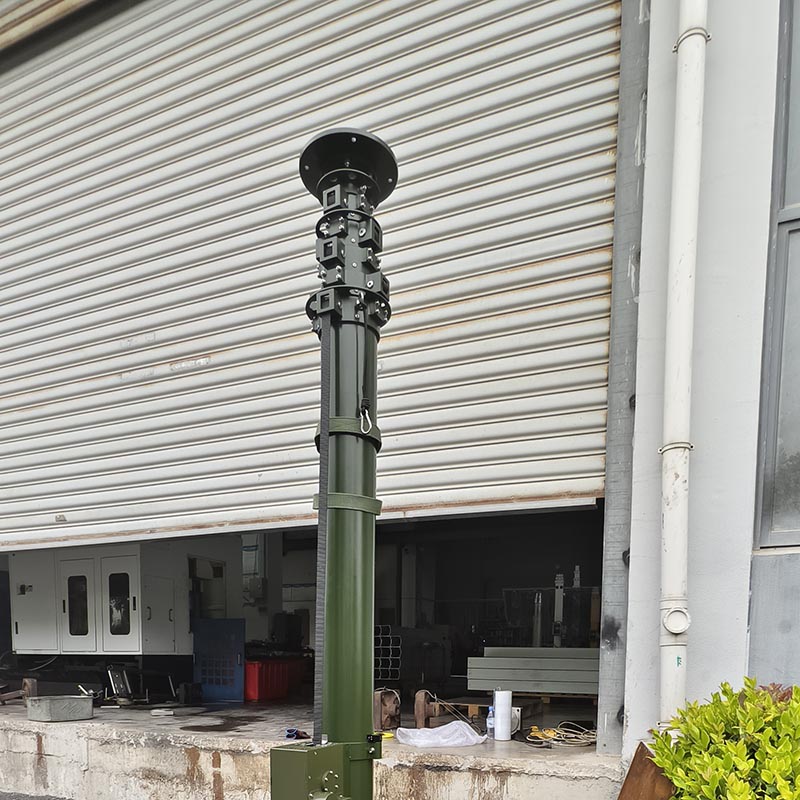
Look for twist-lock or lever-lock sections that let one person extend each stage from the top down. A spring-loaded button lock alone is faster but wears out sooner. The best field designs use a cam-over lever that gives audible and tactile feedback, so even with gloves on you know it is locked.
Not usually. Fiberglass is more flexible and better at insulating the antenna from static buildup, but it needs thicker walls to match the stiffness of aluminum. If the goal is to mount a heavy HF dipole or a small satellite terminal, aluminum or carbon composite is the safer starting point unless weight is the dominant concern.
For temporary setups, a single ground rod at the base plus a short copper strap to the mast bottom is usually enough for static bleed-off. If lightning is a real threat in the area, you will want to lower the mast whenever possible and run a separate ground wire from the antenna mount down to the rod, not through the telescopic joints which can arc.
A realistic test cycle includes repeated extension and retraction under load, a wind tunnel or static pull test at the rated gusts, salt spray exposure for coastal models, and vibration testing on the locking collars. Field trials on uneven ground are just as important because lab tests rarely capture the way soft soil and guy anchor angles shift under tension.
Conclusion
Most off-the-shelf telescopic masts fail the moment they leave a paved lot. In remote field work, the ground is rarely level, wind gusts arrive without warning, and every extra pound of gear matters. Aluminum masts dent easily when knocked against rocks or crammed into transport cases; carbon fiber is lighter and resists corrosion better, but it splinters under sharp impact and costs more to replace. The right custom design pairs an aluminum lower section for ruggedness with a carbon fiber upper for weight savings, then locks them together with quick-release collars that actually grab the tube. Cheap collars slip under cyclic loading, which is why so many field teams watch their antenna slowly droop mid-transmission. A properly machined collar with a cam-over lever and serrated inner face can hold firm even in 40 mph gusts without crushing the tube.
Custom height stops solve the other half of the problem. In crowded RF environments, raising an antenna six inches too high can put it into the beam path of a nearby transmitter and cause interference; fixed detent holes force you to choose between too low and too high. A custom mast can be ordered with an adjustable stop collar that lets you preset exact heights for each site, so one person can extend the mast to the correct mark without looking up or guessing. Coastal salt spray and desert dust are equally hard on standard anodized finishes, which is why custom builders often switch to a hard-coat anodizing or a marine-grade polymer coating on the tubes and stainless steel hardware throughout. The deployment sequence then becomes genuinely one-person: plant the base on a folding tripod, extend the lower section until the first stop clicks, attach the guy lines, raise the upper sections with one hand while the collars self-lock, and tension the guys last. No helper needed, no tool bag, no risk of the mast dropping back down.
Contact Us
Contact Person: Ryan
Email: [email protected]
Tel/WhatsApp: +85259582726
Website: https://www.robomast.com/