
Best Boron Carbide Materials for Extreme Wear and Ballistic Protection
2026-09-13
Boron carbide isn't just another ceramic—it's the material that keeps body armor light and wear plates alive under brutal conditions. Yet not all boron carbide performs the same, and picking the wrong grade can cost you more than money. Before you finalize your next design, here's a look at the top boron carbide options for extreme wear and ballistic protection, along with the supplier that engineers keep coming back to: HUAYI TECH.
Where Hardness Meets Lightweight Armor Demands
Modern armor systems face a stubborn trade-off: increasing hardness often adds weight. Traditional steel plates can stop high-velocity threats, but they quickly exhaust the wearer. Where hardness meets lightweight armor demands, designers turn to advanced ceramic strike faces backed by polymer composite layers. This layered approach exploits the ceramic’s ability to shatter an incoming projectile while the backing absorbs residual energy.
Hardness alone is insufficient if the material cannot survive multiple impacts or handle stress without catastrophic cracking. Boron carbide and silicon carbide offer exceptional Vickers hardness values, yet their brittleness demands careful engineering. Pairing a hard ceramic face with a tough UHMWPE or aramid backing creates a system where the front layer disrupts the threat and the rear layer catches fragments and spreads the load.
Recent advances in pressure-assisted sintering and gradient material design now allow manufacturers to tune porosity and density within a single plate. The result is armor that maintains high hardness thresholds while cutting areal density by a third compared to legacy steel solutions. Instead of relying on brute mass, these systems distribute protection across carefully bonded interfaces, turning material science into a decisive advantage.
How Boron Carbide Handles Extreme Abrasive Wear
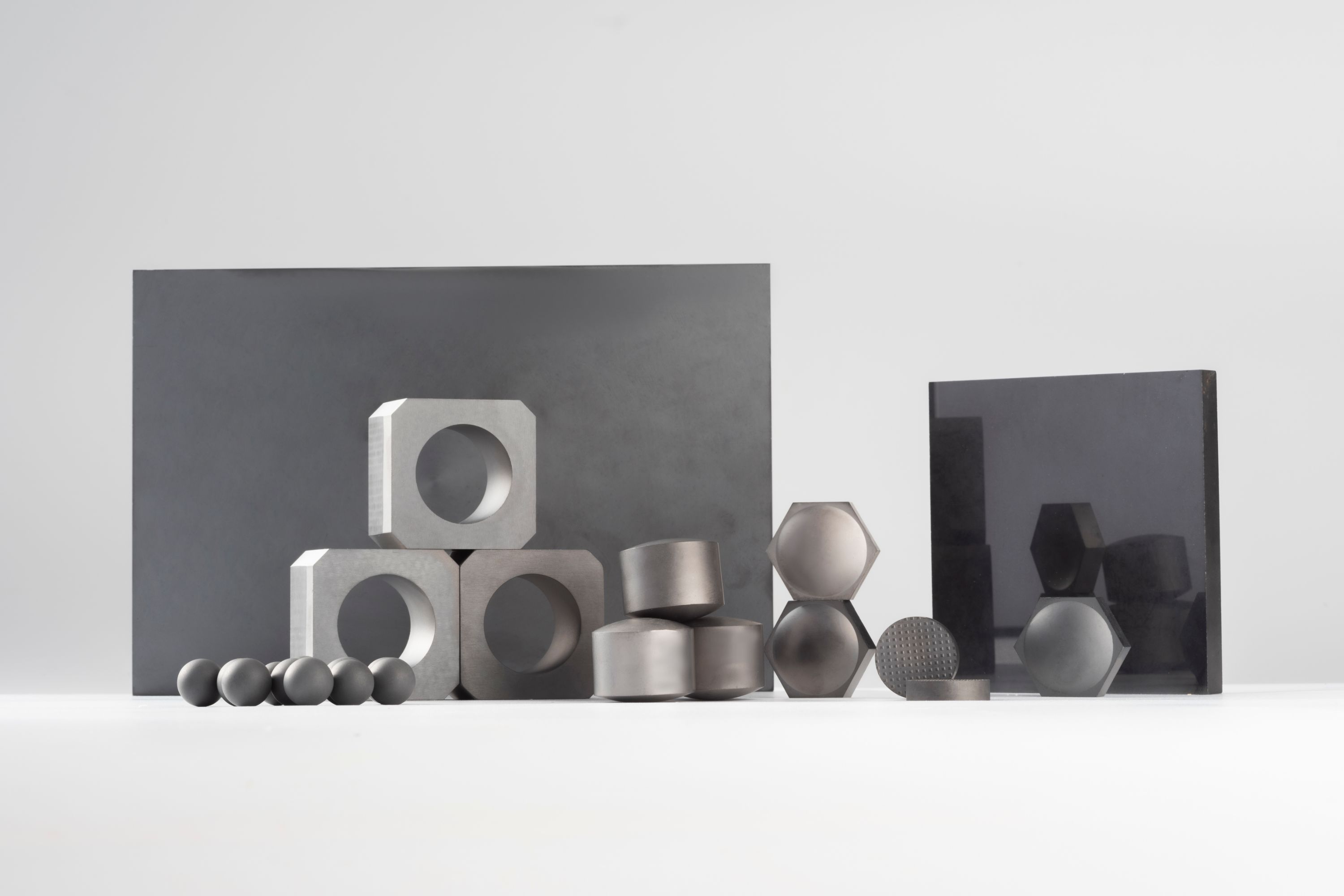
Boron carbide shrugs off abrasive particles that would chew through hardened steel or even alumina. Its Vickers hardness sits around 30 GPa, just below diamond and cubic boron nitride, but what really sets it apart is the way its covalent boron-carbon lattice fails on a micro scale. Instead of polishing smooth under repeated sliding contact, the surface fractures into tiny, sharp-edged fragments, constantly exposing fresh cutting points.
That self-renewing wear mechanism is why boron carbide outlasts tungsten carbide in grit blasting nozzles, water jet orifices, and slurry pump components. The bore doesn't gradually bell out or lose its edge; it keeps a tight flow path and a jagged contact face long after conventional materials have rounded over. In field tests, replacement intervals often stretch several times longer.
Low density adds another practical advantage. Boron carbide weighs about a third as much as tungsten carbide, so rotating and reciprocating parts see less inertial stress while still resisting galling, deformation, and dimensional drift under heavy abrasive load. That combination of hardness, fracture toughness, and lightness makes it a quiet workhorse in armor, nuclear shielding, and high-wear industrial tooling.
Ballistic Plates That Stop More While Weighing Less
Modern ballistic plates have reached a point where protection level no longer has to mean extra weight on your shoulders. By using advanced composite materials like ultra-high-molecular-weight polyethylene and hybrid ceramic layers, these plates can stop rifle rounds while trimming several pounds from your carrier. The result is a setup that keeps you mobile without sacrificing hard armor coverage.
The key to stopping more while weighing less lies in how the plate disperses energy. Instead of relying on thick steel or overbuilt ceramic, newer designs use a mix of strike faces and backers that redirect force outward, catching the bullet before it can penetrate. This means you get multi-hit capability against common threats like 5.56 and 7.62 rounds, yet the plate itself stays under six pounds for a standard 10x12 size.
Field use shows the difference quickly. Users report less fatigue during long shifts, faster movement through tight spaces, and fewer shoulder and back complaints after all-day wear. And because these plates aren't just lighter but also thinner than older models, they fit into streamlined carriers without adding bulk. It's a straightforward upgrade for anyone who needs rifle protection but doesn't want to haul around unnecessary weight.
Choosing the Right Boron Carbide Grade for Your Application
Boron carbide grades are not interchangeable, and the differences often come down to three practical factors: grain size, total purity, and the ratio of boron to carbon. Armor producers, for example, typically look for a fine-grained, hot-pressed material with minimal free carbon because that combination improves multi-hit performance and keeps plate weight down. The same chemistry would be unnecessarily expensive for a blast nozzle that mainly needs resistance to erosion, where a coarser, sintered grade with slightly higher porosity still performs well and costs less.
In nuclear applications, the priority shifts away from mechanical strength toward the isotopic content and trace element profile. A grade enriched in boron-10 with tight control over elements like iron, silicon, and aluminum is essential for control rods and shielding, while ordinary abrasive grit would fail the specification before it ever reached a reactor. Checking the certificate of analysis for those impurities matters more than hardness here, and it is often the deciding factor between a qualified lot and a rejected one.
A useful way to narrow the choice is to define the dominant failure mode first. If the part fails by fracture, a fine-grained grade with high density and low porosity is usually worth the premium. If it fails by gradual wear, a standard purity grade with consistent particle sizing will often do the job. Matching the grade to that failure mode avoids paying for properties you do not need and prevents the more common mistake of using a high-end armor grade in a low-stress lapping application.
Processing Factors That Make or Break Material Performance
A polymer can leave the extruder looking flawless yet fail in service months later. The culprit rarely sits in the raw resin specs alone. Processing conditions—temperature profiles, screw speed, cooling rates, even the shape of the die—quietly rewrite the material's internal architecture. What many call “processability” is really a tug-of-war between thermal history and molecular memory. Melt a polypropylene too fast and you shear-degrade the chains; cool it unevenly and you lock in residual stresses that later become crack initiation points.
Take semi-crystalline thermoplastics. The same nylon grade can show a 20% swing in tensile modulus depending on how it was cooled from the melt. Rapid quenching freezes in a fine spherulitic structure with lower crystallinity but greater impact resistance. Slow cooling lets larger crystals grow, boosting stiffness and chemical resistance but making the part more notch-sensitive. It is not a flaw in the datasheet—it is a processing choice. Weld lines, gate blush, and sink marks are not cosmetic blemishes either; each one maps back to a specific combination of pressure, flow front temperature, and venting.
In injection molding, the difference between a durable hinge and a brittle one often comes down to a ten-degree shift in mold temperature or half a second of holding pressure. Processors who chase cycle time without respecting these thresholds end up optimizing for appearance rather than survival. The materials do not underperform mysteriously; they respond predictably to the conditions imposed on them. True material performance is not an inherent property waiting to be unlocked—it is a fragile agreement between chemistry and the machine.
Pushing Past Traditional Ceramic Limits in Armor Design
Ceramic armor has long traded on a single promise: hardness. The logic runs that if a plate is brittle enough to shatter an incoming projectile, it has done its job. Yet this narrow focus has quietly capped what ceramics can offer. Engineers are now questioning whether the material's failure modes—cracking, spalling, and the abrupt loss of multi-hit capability—are truly inevitable. By rethinking the ceramic itself, rather than simply thickening it or pairing it with heavier backings, a new generation of armor is emerging that bends the old rules.
One promising shift is the move away from monolithic tiles toward engineered microstructures. Instead of a uniform plate that breaks along predictable lines, researchers are designing ceramics with graded porosity, interlocking grains, or embedded ductile phases. These tweaks allow the material to absorb energy through controlled micro-fracturing, spreading damage across a wider area instead of letting a single crack run wild. The result is armor that can take multiple strikes without losing integrity—a capability that traditional designs often sacrifice.
Another frontier involves pairing ceramics with unconventional backings and interfaces. Rather than simply gluing a ceramic face to a metal or composite plate, designers are using thin elastomeric interlayers or functionally graded transitions that manage stress waves more gracefully. This means the ceramic doesn't have to win the battle alone; it can deflect, delay, and distribute the impact energy, letting the backing do its work without catastrophic delamination. The old assumption that ceramics must be monolithic and unforgiving is quietly giving way to a more collaborative material philosophy.
FAQ
Its combination of low density, extreme hardness, and high elastic modulus lets it defeat armor-piercing threats while keeping weight manageable. Compared to alumina, it's roughly 30% lighter at equivalent thickness, and it resists fracture better than silicon carbide under repeated high-velocity impacts.
Modern hot-pressed boron carbide tiles are often engineered with controlled grain boundaries and minimal porosity, which delays crack propagation. In NIJ Level IV plates, it can absorb multiple rifle rounds before spalling becomes a concern, though backer design still plays a decisive role.
With a Vickers hardness around 30-38 GPa and a low coefficient of friction against metals, boron carbide handles abrasive slurries, sandblasting nozzles, and water-jet cutting orifices well where softer ceramics wash out quickly.
Pressureless sintering yields lower cost but usually higher porosity. Hot pressing and spark plasma sintering achieve near-full density and finer microstructures, which translate directly to better dynamic strength. Some newer methods add small amounts of titanium diboride or silicon carbide to improve sinterability without sacrificing hardness.
Yes, boron carbide is brittle and can suffer amorphization under high pressure, which reduces shear strength just behind the impact point. This can increase penetration depth in certain high-velocity threats. Composite designs with polymer backers or ceramic-polymer hybrids help manage the damage zone.
Boron carbide is lighter and slightly harder, but silicon carbide typically shows better multi-hit durability and lower cost. For weight-sensitive applications like aircraft armor or special operations plates, boron carbide wins; for vehicle armor where weight is less critical, silicon carbide is often chosen.
For a standalone Level IV plate, ceramic strike face thickness usually ranges from 7 to 10 mm depending on the exact threat and backing material. In conjunction with an ultra-high-molecular-weight polyethylene backer, some designs can get down to around 7 mm while stopping .30-06 AP.
Not easily. Once fully sintered, boron carbide is extremely hard and cannot be machined with conventional tools except diamond grinding. Recycling typically involves crushing used tiles for use as abrasive grit or feedstock for lower-grade wear parts, not for re-sintering into armor-grade plates.
Conclusion
Boron carbide stands out as one of the few ceramics that genuinely balances extreme hardness with a remarkably low density, making it a top contender for both severe wear environments and ballistic armor. When you need a material that can take a beating without adding unnecessary weight, this is where it shines. Unlike steel or alumina, boron carbide offers a Vickers hardness that rivals diamond while keeping the overall system light enough for mobile applications. In abrasive wear scenarios—think sandblasting nozzles, water jet cutters, or slurry pump components—it resists erosion far longer than most metals and even some other advanced ceramics. The trick is in the microstructure: fine, well-sintered grains minimize pull-out and micro-chipping, so the surface stays smooth under repeated particle impact. But not all boron carbide grades behave the same. Sintering aids, pressure-assisted densification, and grain size control all determine whether you get a tough, reliable component or one that fails prematurely from internal flaws. For armor designers, the payoff is huge: boron carbide plates stop high-velocity threats at a fraction of the weight of steel, which reduces soldier fatigue and allows thicker protection in vehicle panels without sacrificing mobility.
Selecting the right grade comes down to matching the exact threat or wear mechanism to the material's processing history. Hot-pressed boron carbide typically offers better ballistic performance than pressureless sintered versions because it achieves near-full density with fewer residual pores—pores that act as crack initiation sites under impact. However, hot pressing limits shape complexity and raises cost, so some applications turn to reaction-bonded or spark plasma sintered grades for a compromise between performance and manufacturability. Modern armor design is also pushing past traditional monolithic tiles. Multi-curve plates, strikeface arrays, and hybrid composites with polymer backings exploit boron carbide's high compressive strength while mitigating its inherent brittleness. On the wear side, careful grade selection matters just as much: a coarse-grained, low-density boron carbide will spall under high stress, but a fine-grained, fully dense tile can outlast tungsten carbide in dry abrasive conditions. The key is understanding that boron carbide isn't a single material but a family of materials whose final properties depend heavily on raw powder quality, sintering temperature, pressure profile, and post-processing. If you get the processing right, you unlock a material that stops more, weighs less, and keeps working long after lesser ceramics have crumbled away.
Contact Us
Contact Person: Junting Leo
Email: [email protected]
Tel/WhatsApp: +86 18615009766
Website: https://www.huayimaterial-china.com/